01
What’s Inside the A–Z of Aesthetic Concerns?
Clients rarely arrive at a clinic asking for a treatment based solely on its technical name. More often, they describe a concern — tired-looking eyes, sagging skin, pigmentation, enlarged pores, a weak chin, acne scarring, hair thinning or loss of facial volume.
The A–Z of Aesthetic Concerns has been created from that perspective.
It organises common aesthetic concerns alphabetically, providing practitioners with a convenient reference for understanding what may sit behind the concern, how it can present and the types of treatment approaches that may be considered.
Because the contents page won't be displayed separately on the website, below is the complete A–Z list included in the resource.
02
All A–Z Aesthetic Concerns Included
A — Acne • Acne Scarring • Ageing Hands
B — Brow Droop • Bunny Lines • Broken Capillaries
C — Crow’s Feet • Cellulite • Crepey Skin
D — Dark Circles • Dull Skin • Double Chin
E — Enlarged Pores • Eye Bags • Excessive Sweating (Hyperhidrosis)
F — Frown Lines • Forehead Lines • Facial Volume Loss
G — Gummy Smile • Grey/Dull Complexion
H — Hyperpigmentation • Hair Loss • Hollow Temples
I — Intrinsic Ageing • Inflammatory Redness
J — Jawline Sagging (Jowls) • Jaw Clenching (Bruxism)
K — Knees (Saggy Skin) • Keratosis Pilaris
L — Lip Lines • Loose Skin • Lymphatic Puffiness
M — Marionette Lines • Melasma • Migraines (Medical)
N — Nasolabial Folds • Neck Bands • Nose Shape Concerns
O — Oily Skin • Open Pores
P — Pigmentation • Post-Acne Marks • Post-Surgical Scars
R — Rosacea • Rough Skin Texture • Red Veins
S — Sagging Skin • Smoker’s Lines • Stretch Marks • Sun Damage
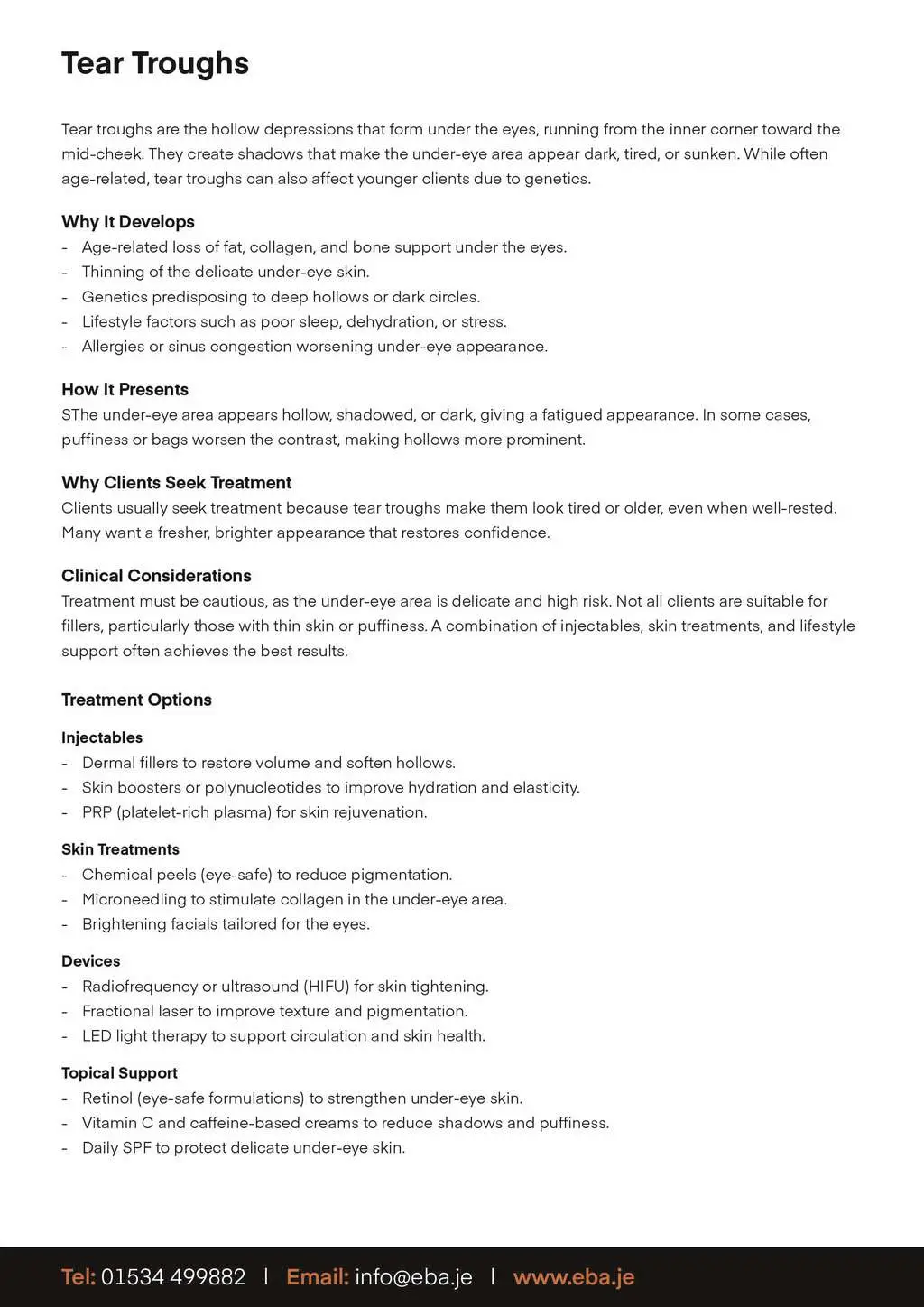
T — Tear Troughs • Thinning Hair • Turkey Neck
U — Uneven Skin Tone • Under-Eye Hollows
V — Volume Loss (Cheeks/Lips/Hands) • Varicose Veins (Surface Concerns)
W — Wrinkles (General) • Weak Chin • Weight-Related Fat Pads
Y — Youthful Glow Loss (Dullness, Texture)
03
More Than an A–Z List
The value of the resource is in the information sitting behind each concern.
Each entry is developed as a practitioner reference rather than simply providing a definition. For example, the Acne section explains the condition and then moves through Why It Develops, How It Presents, Why Clients Seek Treatment, Clinical Considerations and Treatment Options.
This structure helps practitioners look at a concern from several angles rather than immediately jumping from a client's complaint to a particular treatment.
04
Why It Develops
Where relevant, the resource explores factors that may contribute to the development or appearance of a concern.
This helps provide context around what the client is presenting with and reinforces the importance of understanding the concern itself before considering possible treatment options.
05
How It Presents
The reference also describes how concerns may commonly appear or present.
For practitioners, this provides a useful educational reference when discussing different aesthetic presentations during consultation and when distinguishing between concerns that may appear similar.
06
Why Clients Seek Treatment
Aesthetic concerns are not experienced in exactly the same way by every client.
The resource considers why a particular concern may lead someone to seek professional treatment, adding the client perspective alongside the more clinical description of the concern.
07
Clinical Considerations
Importantly, the A–Z also incorporates clinical considerations.
These sections highlight factors that may need further thought during consultation — including circumstances where medical history, medication, the nature of the concern or other relevant factors could affect the treatment conversation.
For example, the Acne entry specifically notes the importance of consultation, possible hormonal, medication and health influences, treatment restrictions associated with isotretinoin, and distinguishing active acne from acne scarring.
08
Exploring Potential Treatment Approaches
Where appropriate, the resource then considers different categories of treatment or support that may be relevant to the concern.
Rather than restricting the practitioner to one treatment type, entries can explore approaches across areas such as injectables, skin treatments, devices and topical support, depending on the individual concern. The Acne entry, for example, demonstrates this multi-category structure.
The resource is therefore designed as an educational and consultation reference, with individual treatment suitability still requiring appropriate professional assessment.
09
A Useful Consultation & Treatment-Planning Reference
With concerns organised alphabetically, practitioners can quickly locate the subject they want to revisit.
It can be particularly useful when preparing for consultations, refreshing knowledge around a particular presentation, considering different treatment categories or helping newer practitioners develop a broader understanding of the range of concerns encountered within aesthetics.
10
Personalised to Your Clinic
Your A–Z of Aesthetic Concerns is professionally personalised and branded throughout, creating a polished practitioner reference that fits cohesively alongside your other clinic manuals and documentation.
The completed 63-page resource is supplied as a high-quality PDF directly by email.
For practical clinic use, we recommend printing and storing the resource in a ring binder with protective pockets, creating an accessible A–Z reference that can be kept within the clinic for ongoing practitioner use.
Important: Your documentation is tailored to the information you provide. Individual practitioners remain responsible for checking requirements applicable to their qualifications, insurer, treatments, premises and regulatory environment.